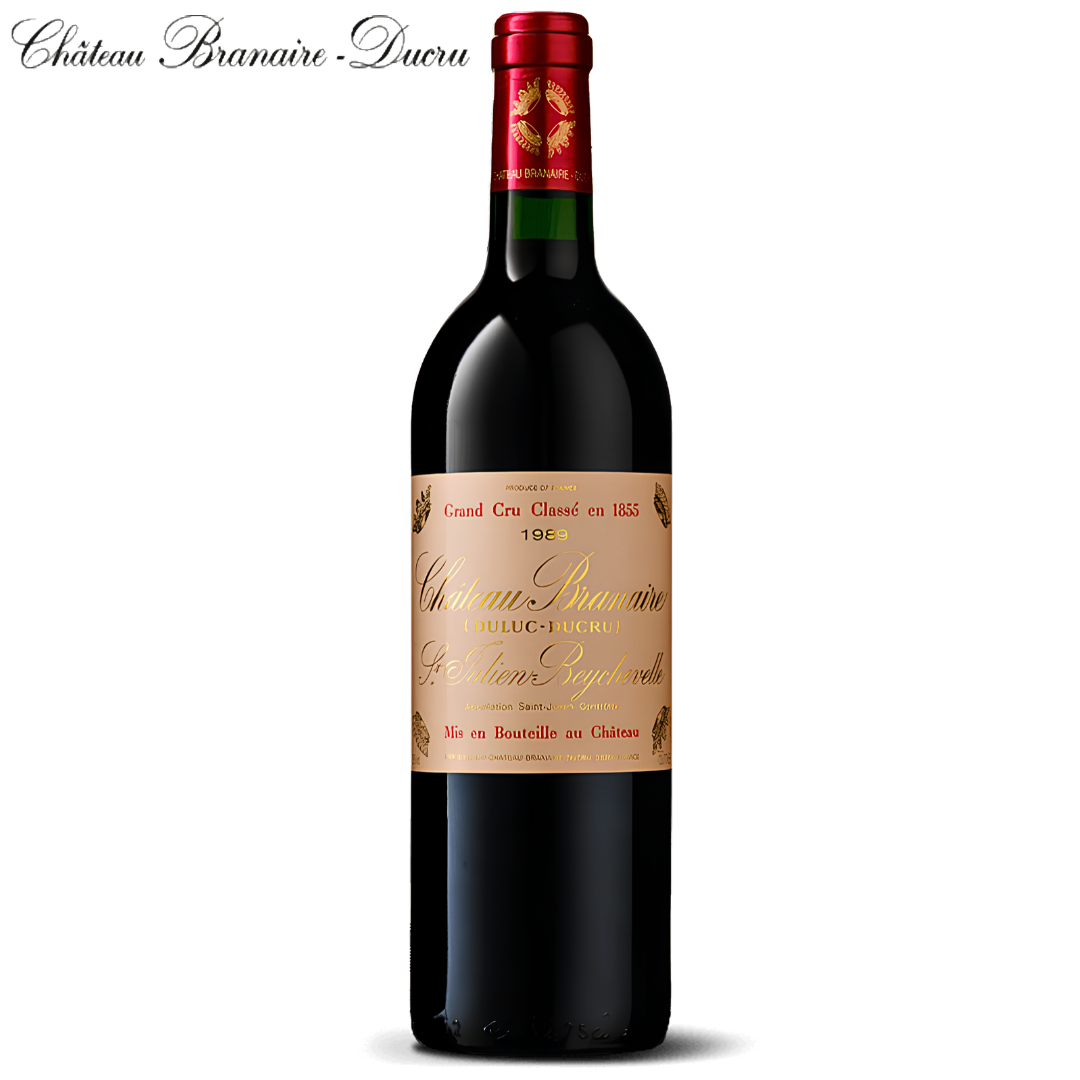

Château Branaire-Ducru Saint-Julien Grand Cru Classe 1989
Château Branaire-Ducru
Couldn't load pickup availability

Château Branaire-Ducru 1989
Description
Château Branaire-Ducru 1989 is a remarkable mature Bordeaux from the prestigious Saint-Julien appellation, classified as a Fourth Growth in the historic 1855 Bordeaux Classification and designated a Legendary vintage by the château itself. With its exceptionally early harvest, enduring fruit character, impressive freshness and distinguished pedigree, the wine offers a fascinating expression of mature Left Bank Bordeaux.
Produced at one of Saint-Julien's historic classified estates, the 1989 vintage reflects a particularly memorable growing season. Initial concerns about spring frost gave way to rapid vine development from May onward, followed by intensely warm weather in June and July. These conditions encouraged early grape maturation and one of the earliest harvests recorded in the region that year.
Harvest began at Château Branaire-Ducru on 31 August 1989, an unusually early date that became a defining feature of the vintage. The château recalls the optimism surrounding the harvest and now includes the year among the exceptional vintages in its historical archive.
In its retrospective assessment, the estate particularly emphasises the wine's abundant fruit, striking freshness, intense colour, pronounced tannins and remarkable length. These qualities demonstrate why 1989 has retained a special place in the history of Château Branaire-Ducru.
Professional tastings over subsequent decades have described layers of ripe raspberry, blackcurrant and other red fruits alongside developed notes of cedar, tobacco, pencil shavings, truffle and earthy complexity. Such characteristics reflect the evolution of a traditionally structured Saint-Julien Bordeaux through extended bottle ageing.
On the palate, historical reviews have recognised supple fruit, balanced acidity and an appealing combination of structure and elegance. With age, the original primary fruit and tannins may become increasingly integrated with savoury, earthy and tertiary aromas, although the precise character of an older wine depends on the condition and storage history of each individual bottle.
The vintage is also significant because it was produced soon after Patrick Maroteaux acquired the château in 1988. It therefore belongs to the opening years of a new chapter in the estate's modern history, before the introduction of its later gravity-assisted winemaking facilities.
For collectors and enthusiasts of mature Bordeaux, Château Branaire-Ducru 1989 offers a compelling combination of historical significance, Saint-Julien finesse, Fourth Growth heritage and decades of bottle development. It is particularly suited to special anniversaries, distinguished dining occasions and collections devoted to mature French wines.
Official 1989 Vintage Conditions
The château's account of the 1989 growing season describes a year that began with uncertainty but developed into a particularly memorable harvest.
Early Season: Repeated concerns about frost initially created uncertainty for the vineyard. These risks made the opening stages of the growing season particularly sensitive.
May: With improving weather conditions, the vines began developing rapidly. Their accelerated growth signalled the beginning of an unusually early season.
June and July: Both months experienced very hot weather. The favourable warmth encouraged vigorous grape development and the continued advancement of fruit maturity.
Harvest: Picking began on 31 August 1989, among the earliest starts in the Saint-Julien area. The unusually advanced harvest reflected the rapid progression of the growing season.
Harvest Expectations: The estate remembers widespread enthusiasm and optimism about the quality of the fruit and the prospects for the finished wine.
Retrospective Assessment: The château describes the wine as retaining abundant fruit and freshness, together with intense colour, perceptible tannins and an exceptionally long finish.
Vintage Recognition: Château Branaire-Ducru includes 1989 within its official Legendary vintage collection, recognising the historical importance and character of the wine.
Producer's Serving Advice: The château specifically recommends allowing the wine to breathe before tasting. For an individual mature bottle, the appropriate aeration period should be determined by its present condition.
These observations are based on the château's own published account rather than a reconstruction using information from neighbouring vintages.
Official Tasting Notes & Sensory Profile
Château's Official Description: An expressive, fruit-rich wine that has retained notable freshness, with intense colour, perceptible tannins and impressive length.
Appearance: The château highlights the vintage's intense colour. Mature examples may show garnet development and amber tones at the rim, as observed in independent retrospective tastings.
Primary Fruit: Raspberry, blackcurrant and ripe red berries are noted in professional reviews of the 1989 wine.
Developed Aromas: Cedar, tobacco, pencil shavings, truffle and earthy nuances have been reported in tastings conducted after extended bottle ageing.
Palate: Historical reviews describe an attractive balance between ripe fruit, supple texture, structure and refreshing acidity.
Tannins: The château specifically identifies a noticeable tannic presence. Subsequent bottle maturation may soften the texture, depending on the wine's provenance and storage.
Freshness: One of the vintage's defining features in the château's account is its sustained freshness despite the considerable time elapsed since harvest.
Finish: The producer emphasises length and persistence, while independent tastings have recorded lingering ripe fruit, mint and savoury characteristics.
Overall Character: A mature, fruit-expressive Saint-Julien Bordeaux with historic structure, aromatic development and the refined elegance associated with Château Branaire-Ducru.
Specific fruit and savoury descriptors come from dated critic reviews. They are not guaranteed to appear in every surviving bottle of this vintage.
Critical Acclaim & Historical Reviews
Château Branaire-Ducru 1989 has been reviewed repeatedly over several decades. These assessments provide valuable perspectives on the wine's development, although the results naturally vary with tasting date and individual bottle condition.
- 91 Points — Vinous / International Wine Cellar, Ian D'Agata, March 2014: D'Agata observed ripe red fruit accompanied by earthy and truffle-like complexity, with a fresh, balanced palate. The review also records the exceptionally early 1989 harvest.
- 90 Points — The Wine Advocate, Robert Parker, December 2002: Parker described raspberry and blackcurrant fruit with complementary cedar, pencil-shaving, chocolate and oak notes, supported by a supple texture and appealing richness.
- 90 Points — Wine Spectator, May 1999: Recognised for its balance, freshness, floral and raspberry aromatics, integrated tannins and fruit-driven finish.
- 18.5/20 — Chris Kissack, The Wine Doctor, January 2002: This historical assessment praised the wine's structure, fruit concentration, cedar character and balanced acidity.
An earlier Robert Parker assessment, reproduced by specialist auction houses, presents a more enthusiastic evaluation of the wine's richness and seamless texture. Historical merchant records display a 92-point rating for that assessment, while Parker's later Wine Advocate review is listed at 90 points.
Collector Perspective: The appeal of a wine from 1989 extends beyond numerical ratings. Vintage provenance, the château's historical assessment, proper storage and the preservation of an individual bottle are particularly important to collectors of mature Bordeaux.
The ratings cited above refer specifically to Château Branaire-Ducru 1989, not to the château's more recent vintages or its second wine, Duluc de Branaire-Ducru.
Historic Winemaking & Grape Composition
Château Branaire-Ducru is traditionally associated with Cabernet Sauvignon-led Bordeaux blends, complemented by other classic Médoc varieties including Merlot, Cabernet Franc and Petit Verdot.
A 2014 professional review by Ian D'Agata reports a blend of 75% Cabernet Sauvignon, 20% Merlot, 3% Cabernet Franc and 2% Petit Verdot for the 1989 vintage.
Source Qualification: These proportions are attributed to the reviewer. The château's official 1989 vintage account does not independently confirm them, so they should not be represented as a verified estate technical specification.
The 1989 vintage was produced during the earliest years of the Maroteaux family's ownership, following its acquisition of Château Branaire-Ducru in 1988.
The château's pioneering modern gravity-assisted vat room was installed in 1991, after the 1989 harvest. Consequently, the modern cellar's technical features should not be attributed to the production of this historical wine.
Similarly, the producer's current oak-ageing programme should not be presented as the exact maturation method for 1989 without vintage-specific documentary confirmation.
The wine's identity is best understood through its historic Saint-Julien terroir, early harvest, traditional Bordeaux character and the château's own retrospective tasting assessment.
Saint-Julien Terroir & 1855 Classification
Château Branaire-Ducru lies in Saint-Julien, a distinguished Médoc appellation situated between Margaux and Pauillac on Bordeaux's Left Bank.
The estate's terroir is characterised by gravel and pebble deposits of ancient river origin. These well-drained soils are especially favourable to Cabernet Sauvignon, while clay-influenced areas provide suitable conditions for Merlot.
The proximity of the Gironde estuary contributes to the maritime influence that shapes the region's viticultural conditions.
In 1855, Château Branaire-Ducru was included among the distinguished classified growths of the Médoc as a Fourth Growth, or Quatrième Grand Cru Classé.
This historic classification is an important part of the estate's identity, recognising its longstanding position among Bordeaux's notable wine properties.
The château's recognised stylistic signature centres on fruit, freshness and elegance, qualities that reflect the refined character historically associated with Saint-Julien.
The 1989 vintage connects this distinguished terroir and classified-growth heritage with a memorable growing season and the complex evolution of mature Bordeaux.
BBPH Serving & Mature-Bottle Guidance
As a wine harvested in 1989, Château Branaire-Ducru 1989 requires more individualised serving and handling than a recently released Bordeaux.
- Suggested Serving Temperature: Approximately 16–18°C, allowing the wine's fruit, savoury aromatics and mature character to emerge without excessive warmth.
- Before Opening: Stand the bottle upright beforehand if sediment is suspected, allowing deposits to settle.
- Cork Care: Open gently using an appropriate mature-wine corkscrew or two-pronged cork puller when necessary. Older corks may be fragile.
- Initial Assessment: Taste a small portion shortly after opening to assess aromatic condition, fruit, freshness and structural balance.
- Aeration: The château recommends letting the 1989 breathe. For a mature bottle, determine the degree of aeration from its actual condition instead of automatically applying a prolonged decanting period.
- Sediment Management: Decant gently if sediment needs to be separated from the clear wine, taking care not to expose a delicate bottle unnecessarily to air.
- Glassware: Use a clean, generous Bordeaux-style wine glass to appreciate the wine's layered aromas.
- Further Cellaring: Evaluate provenance, fill level, cork integrity and storage history before deciding whether to cellar an older bottle any longer.
- After Opening: Enjoy while the wine remains expressive. Mature bottles can change more rapidly after exposure to oxygen.
Important: The château's historical description of 1989 as a wine for keeping reflects its original ageing character. It does not establish that every bottle available today remains suitable for indefinite further storage.
These practical handling suggestions are provided by Barrels & Beyond PH. The instruction to allow the wine to breathe comes from the château's official vintage account.
BBPH Food Pairing Suggestions
Mature Saint-Julien Bordeaux pairs particularly well with dishes that complement developed fruit, earthiness, savoury complexity and an elegant tannic structure.
- Roast Beef: Tender, herb-roasted beef with a delicate savoury jus.
- Beef Tenderloin: Gently roasted tenderloin with porcini mushrooms or a restrained red wine reduction.
- Rack of Lamb: Rosemary-crusted lamb with roasted garlic and seasonal vegetables.
- Duck Breast: Pan-seared duck with mushrooms, thyme or a light savoury accompaniment.
- Roast Veal: Tender veal with aromatic herbs and a delicate mushroom sauce.
- Roast Poultry: Herb-roasted chicken or guinea fowl with earthy, restrained accompaniments.
- Wild Mushrooms: Sautéed porcini, mushroom tart or a carefully balanced mushroom risotto.
- Black Truffle: Delicately truffled meat or mushroom dishes that complement the wine's mature aromatics.
- Aged Cheese: Firm, moderately mature cheeses selected to complement rather than overpower the wine.
Avoid excessively sweet sauces, aggressive chilli heat and very heavily seasoned dishes that may conceal the finer aromas of mature Bordeaux.
These culinary suggestions are curated by Barrels & Beyond PH and are not presented as official château recommendations.
Technical Information
- Producer: Château Branaire-Ducru
- Wine Name: Château Branaire-Ducru 1989
- Vintage: 1989
- Wine Type: Dry Still Red Wine
- Style: Mature Bordeaux Red Blend
- Country: France
- Region: Bordeaux
- Subregion: Médoc, Left Bank
- Appellation: Saint-Julien AOC
- Classification: Fourth Growth, 1855 Grand Cru Classé
- Official Vintage Designation: Legendary
- Principal Grape: Cabernet Sauvignon
- Other Traditional Varieties: Merlot, Cabernet Franc, Petit Verdot
- Exact 1989 Blend: Not Confirmed by Château Technical Documentation
- Exact Alcohol Content: Confirm from Supplied Bottle Label
- Bottle Size: 750ml
- Harvest Start: 31 August 1989
- Growing Season: Early Frost Concerns; Rapid Growth from May; Hot June and July
- Official Sensory Profile: Fruit-Rich, Fresh, Deeply Coloured, Structured, Long
- Official Serving Advice: Allow Wine to Breathe Before Tasting
- 1989-Specific Oak Ageing: Not Independently Verified
- Vinous / International Wine Cellar: 91 Points, Ian D'Agata, 2014
- The Wine Advocate: 90 Points, Robert Parker, 2002
- Wine Spectator: 90 Points, 1999
- The Wine Doctor: 18.5/20, Chris Kissack, 2002
- BBPH Serving Temperature: Approximately 16–18°C
- Mature-Bottle Handling: Assess Condition Before Decanting
- Food Pairings: Beef, Lamb, Duck, Veal, Roast Poultry, Mushrooms, Truffle
- Allergen Information: Verify Sulphite Declaration on Supplied Bottle
- Second Wine of Estate: Duluc de Branaire-Ducru
About Château Branaire-Ducru
Château Branaire-Ducru is a distinguished Bordeaux estate situated in Saint-Julien, on the Left Bank of the Médoc.
The estate's recorded history begins in 1680, when Jean-Baptiste Braneyre acquired vineyard land previously belonging to the extensive Beychevelle estate. He recognised the potential of the area's gravelly terroir for producing exceptional wine.
In 1824, his descendants, the Du Luc family, built the château that became an important part of the property's identity. The estate later passed to Gustave Ducru, whose family retained ownership until 1919.
Château Branaire-Ducru received Fourth Growth status in the historic Bordeaux Classification of 1855, establishing its position among the distinguished classified wine estates of the Médoc.
Patrick Maroteaux acquired the property in 1988 and began an ambitious period of renewal focused on the vineyards, cellars and the overall precision of winemaking.
The 1989 vintage is particularly interesting because it was produced immediately after this change of ownership and before the introduction of the château's modern gravity-assisted vat room in 1991.
Under subsequent generations of the Maroteaux family, the estate continued developing its approach to expressing the exceptional Saint-Julien terroir.
The château's distinctive house style is defined by three essential qualities: fruit, freshness and elegance.
Château Branaire-Ducru 1989 represents a historic expression of this heritage, preserving the character of a memorable harvest and offering a mature perspective on one of Bordeaux's great classified estates.
Why We Love It
At Barrels & Beyond PH, we appreciate Château Branaire-Ducru 1989 for its historical significance, distinguished Saint-Julien origins and the fascination of an exceptional mature vintage.
The château's Legendary designation, exceptionally early harvest and retrospective description of enduring fruit and freshness make 1989 particularly appealing to collectors and enthusiasts who appreciate the evolution of fine Bordeaux.
Whether selected for a milestone anniversary, a thoughtfully curated collection or an exceptional dining occasion, Château Branaire-Ducru 1989 offers the heritage and mature character of a historic 1855 classified growth.
Ordering & Payment
Ordering & Payment
Complete checkout with your selections and preferred delivery or pickup option. We will email your billing invoice with the available payment options. If a product is unavailable, our team will be happy to suggest a suitable alternative.
Delivery
Delivery
Delivery is available within and beyond Metro Manila. Fees are calculated at checkout based on the delivery address. Pickup is also available from our Pasig location.
Returns & Product Concerns
Returns & Product Concerns
If you received an incorrect, defective, or damaged item, please contact us within 24 hours of delivery or pickup and provide your order reference and clear photos. Our team will guide you through the next steps in accordance with our Refund Policy and applicable law.