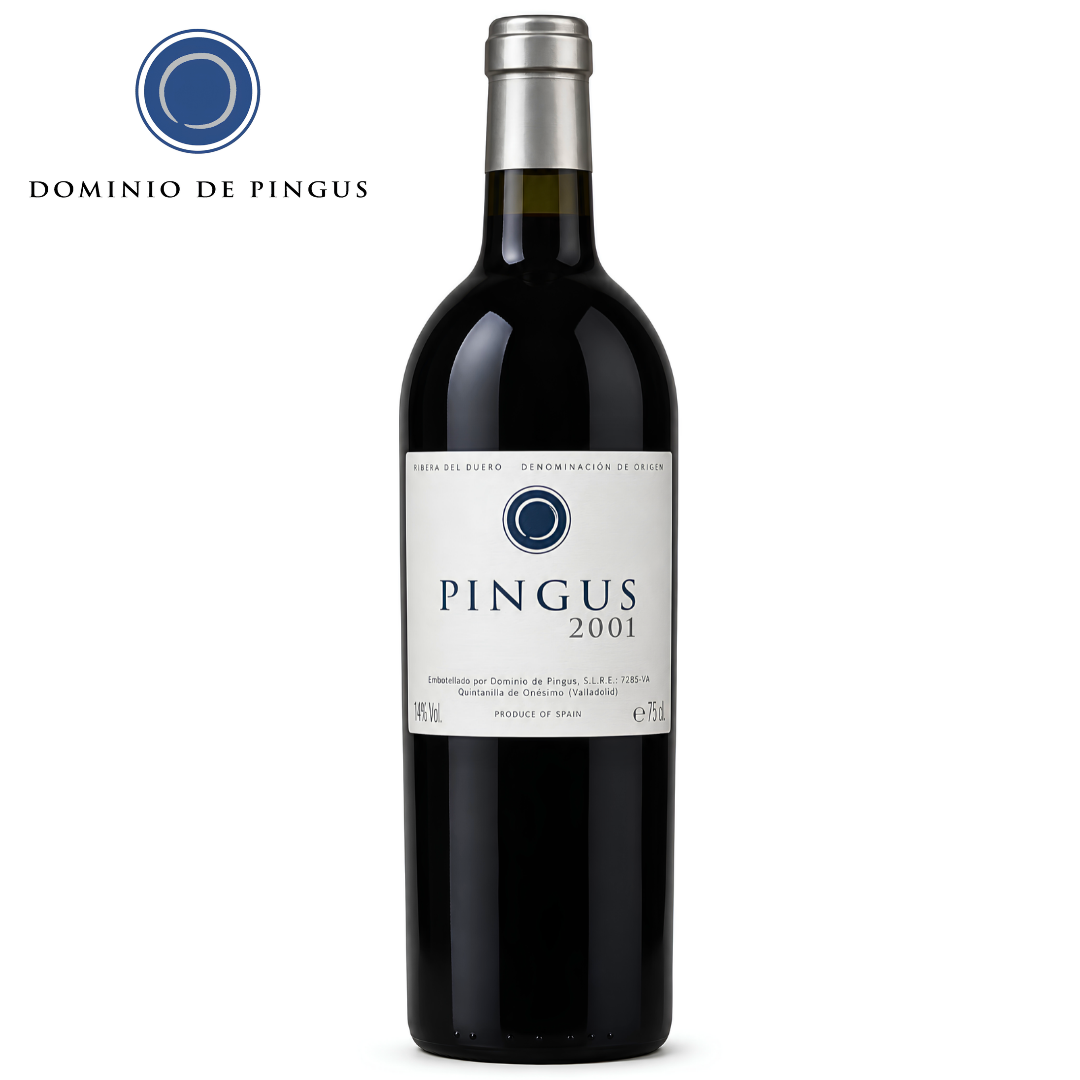

Dominio de Pingus Pingus Ribera del Duero 2001
Dominio de Pingus
Couldn't load pickup availability
Dominio de Pingus Pingus 2001
Description
Dominio de Pingus Pingus 2001 is an iconic Spanish fine wine, awarded 95 points by Robert Parker and Stephen Tanzer, with an additional 95-point retrospective assessment from Neal Martin. Produced by Danish winemaker Peter Sisseck from exceptionally low-yielding, old-vine Tempranillo in Ribera del Duero, this distinguished vintage combines extraordinary concentration, rich dark fruit, complex savoury aromatics and a remarkably persistent finish.
Pingus occupies a singular position in modern Spanish winemaking. Created in 1995, it rapidly became one of the country's most internationally sought-after wines, demonstrating the extraordinary potential of carefully cultivated old-vine Tinto Fino in the high-altitude vineyards of Ribera del Duero.
The 2001 vintage represents an important early chapter in the development of Peter Sisseck's project. The Ribera del Duero Regulatory Council officially awarded the growing year its highest classification, Excelente, recognising its exceptional overall quality.
Sourced from old vines in the La Horra area, Pingus is made entirely from Tinto Fino, the local expression of Tempranillo. The wine is associated with the Barroso and San Cristóbal vineyards, where limestone-rich clay and gravel soils contribute to its concentrated, distinctly mineral and structured character.
The estate's philosophy combines intensely selective vineyard cultivation, low yields and meticulous winemaking. Peter Sisseck introduced biodynamic practices around the turn of the millennium, seeking healthier vines, improved balance and a more faithful expression of the estate's terroir.
The 2001 vintage has been praised for its impressive union of power and restraint. Robert Parker's April 2004 review recognises a deeply coloured, firmly structured wine with enormous fruit concentration, substantial body and an extraordinarily long finish.
The bouquet is rich and complex, showing dark blackberry and blackcurrant fruit layered with grilled meat, Mediterranean herbs, black pepper, tobacco, cigar smoke and warm spice. A distinctive smoky quality contributes further intensity and depth.
Stephen Tanzer's September 2004 tasting describes a different but complementary dimension of the wine, with cherry, raspberry, liquorice, smoked meat, mineral complexity, dark chocolate and refined oak. He particularly admires its silky texture and the persistence of its fine tannins.
In a later March 2013 assessment, Neal Martin found a beautifully defined bouquet of plum, boysenberry and briar fruit, supported by crushed stone, hickory smoke, minerals and white pepper. His review highlights the balance, poise and structural precision that distinguish the 2001 from a merely powerful red wine.
The palate is full-bodied and deeply expressive, with saturated dark fruit, savoury complexity and an impressive tannic framework. Despite its considerable concentration, the wine has repeatedly been recognised for maintaining freshness, balance and exceptional length.
Originally evaluated as a wine requiring substantial bottle maturation, Pingus 2001 has now developed over a quarter of a century since harvest. Individual bottles may reveal additional tobacco, leather, earth, truffle, dried-fruit and savoury characteristics, depending on provenance and storage.
Its exceptionally limited production adds to its rarity. Wine Spectator's vintage-specific review reports approximately 500 cases made, reflecting the small-scale character of the Pingus project and its demanding selection standards.
For collectors and enthusiasts of Spain's greatest red wines, Pingus 2001 offers an extraordinary combination of historic significance, old-vine Tempranillo purity, 95-point critical recognition and the mature complexity of a celebrated Ribera del Duero vintage.
The 2001 Vintage: An Excelente Year in Ribera del Duero
The 2001 vintage holds a distinguished place in the history of Ribera del Duero. The appellation's Regulatory Council officially classified the year as Excelente, its highest quality designation.
Regional Growing Conditions: Contemporary harvest reporting describes a challenging spring marked by frost damage in parts of Ribera del Duero, reducing potential crop volumes across the appellation.
Vineyard Health: Some areas experienced mildew pressure, although subsequent favourable ripening conditions helped produce healthy fruit and encouraging quality prospects.
Ripening Season: Weather became particularly favourable through much of the growing period, allowing Tempranillo to develop ripe fruit flavours and structural concentration.
September: Contemporary regional reports describe favourable weather in mid-September, followed by cooler and wetter conditions in some areas that influenced harvest decisions.
Harvest Timing: Regional growers began picking from late September, although individual vineyards followed their own schedules according to fruit maturity and conditions.
Vintage Qualification: These observations describe Ribera del Duero as a region. The precise effects of frost, rainfall and disease pressure on the individual Pingus vineyards are not established by a dedicated 2001 estate harvest report.
Official Vintage Recognition: The Consejo Regulador de la Denominación de Origen Ribera del Duero awarded 2001 its Excelente classification, identifying the year among the appellation's highest-rated harvests.
Pingus 2001: The finished wine demonstrates the potential of the vintage through its remarkable fruit concentration, substantial structure, impressive balance and long, complex finish, as documented by multiple professional critics.
The quality of this vintage is especially significant in the early history of Dominio de Pingus, following the estate's first commercial harvest in 1995 and the introduction of biodynamic vineyard practices around 2000–2001.
Professional Tasting Profile
Appearance: Deep, opaque ruby-purple in Robert Parker's original tasting, reflecting the concentration and extraction characteristic of this early Pingus vintage. Mature bottles may now show garnet development.
Black-Fruit Aromas: Blackberry, blackcurrant, cassis, dark plum and boysenberry, described in professional assessments of the 2001 wine.
Red-Fruit Character: Cherry and raspberry, particularly noted by Stephen Tanzer, adding aromatic lift and complexity to the darker fruit.
Herbal Aromas: Mediterranean herbs and subtle briar-like notes accompany the ripe berry fruit.
Spice: Black pepper, white pepper, liquorice and warm spice-box impressions contribute intensity and sophistication.
Smoky and Savoury Aromas: Grilled meat, smoked meat, cigar smoke, tobacco, hickory and barbecue-like nuances are among the distinctive characteristics identified by reviewers.
Earthy and Mature Notes: Black truffle, earth and savoury complexity feature in historical reviews. Their present intensity depends on bottle development.
Oak and Chocolate: Bitter chocolate, coffee, roasted nuances and smoky oak appear in independent assessments.
Mineral Character: Crushed stone and mineral notes provide a contrasting element to the wine's powerful fruit.
Body: Full-bodied and concentrated in original reviews, with Neal Martin's later tasting emphasising a more measured, medium-bodied sense of poise.
Texture: Rich and generous, with silky fruit and substantial yet carefully structured tannins.
Freshness: Noticeable balancing acidity and tension, preventing the concentrated fruit from appearing excessively heavy.
Finish: Exceptionally long, with lingering dark fruit, smoke, spice, mineral impressions and persistent tannins.
Overall Style: A powerful yet refined old-vine Spanish Tempranillo, combining extraordinary concentration with aromatic depth, structure and mature-wine complexity.
These descriptors are drawn from dated professional reviews of Pingus 2001. They are not presented as a producer-authored vintage tasting sheet, and the character of an individual bottle will depend on storage and condition.
Critical Acclaim and Professional Reviews
Pingus 2001 has received outstanding recognition from leading international wine critics, including 95 points from Robert Parker, 95 points from Stephen Tanzer and 95 points from Neal Martin in a later retrospective tasting.
- 95 Points — Robert Parker, The Wine Advocate, April 2004: Parker highlights the wine's extraordinary concentration, firm structure and enormous fruit intensity. His assessment describes blackcurrant and blackberry accompanied by grilled meats, Mediterranean herbs, pepper, cigar smoke and a powerful smoky character. He particularly admires the exceptionally lengthy finish.
- 95 Points — Stephen Tanzer, International Wine Cellar, September 2004: Tanzer recognises cherry, raspberry, liquorice, smoked meat, mineral complexity, dark chocolate and smoky oak. His review emphasises an unusually silky texture, considerable aromatic depth and a lengthy finish with refined tannins.
- 95 Points — Neal Martin, The Wine Journal, March 2013: Martin's retrospective tasting identifies dark plum, boysenberry, briar fruit, crushed stone, hickory smoke and white pepper. He praises the wine's definition, tension, balance and structural poise.
- 94 Points — Wine Enthusiast, June 2005: The review recognises remarkable concentration and an intense aromatic profile of coffee, earth, black truffle and smoked meat, followed by saturated dark fruit and substantial tannins.
- 93 Points — Wine Spectator, November 2004: The review highlights the balance between power and restraint, with plum, coffee, tobacco, mineral character and a firm tannic framework. It recognises the freshness and length of the finish and designates the wine Collectible.
Critical Perspective: The original reviews emphasise the wine's enormous concentration and substantial structure, while Neal Martin's later tasting provides a valuable perspective on its balance and development after additional years in bottle.
Wine Spectator's 2004 review also reports approximately 500 cases produced, reinforcing the wine's reputation for limited availability.
Robert Parker originally suggested a maturity period of 2010–2028. This represents the critic's historical estimate, not a guarantee that every bottle will remain in excellent condition throughout that period.
The 2001's strongest distinction is its consistent recognition for concentration, complexity, balance and remarkable persistence from multiple independent critics.
Old-Vine Tinto Fino and the La Horra Vineyards
Pingus is produced from 100% Tinto Fino, the traditional local name for Tempranillo in Ribera del Duero.
The wine originates from selected old-vine parcels in La Horra, a village within the Ribera del Duero region of Castilla y León.
Barroso Vineyard: Identified in specialist producer-distributor profiles as an approximately 2.5-hectare old-vine parcel contributing fruit to Pingus.
San Cristóbal Vineyard: A second historic parcel described as approximately 1.5 hectares, also associated with the flagship wine's production.
Vine Age: Distributor technical documents identify both vineyards as containing old plantings dating to 1929. These historic plantings are central to the producer's philosophy of low yields and concentrated fruit.
Soils: Limestone-rich clay and gravel contribute to the vineyard environment, supporting vine development and the expression of Tinto Fino.
Low Yields: Specialist estate profiles report average yields of approximately 12 hectolitres per hectare for Pingus. This is an estate-level figure rather than a verified 2001-specific harvest yield.
Manual Harvesting: Grapes are harvested by hand, allowing careful assessment and selection of fruit.
Biodynamic Vineyard Management: Pingus adopted biodynamic methods around 2000–2001, seeking greater vineyard balance and a more precise expression of the natural terroir.
The combination of old vines, demanding selection and low yields helps explain the intensity and distinctiveness of Pingus, while the selected terroir contributes to the wine's structure and mineral complexity.
Winemaking and Historical Oak Maturation
Peter Sisseck created Pingus as a small-scale, terroir-driven project, combining meticulous work in the vineyard with careful fermentation and maturation.
Grape Selection: The production of Pingus begins with hand-harvested Tinto Fino from carefully selected old-vine parcels, with particular attention to vine health, ripeness and fruit quality.
Fermentation: The estate's historic approach uses wooden fermentation vessels, preserving close control over the vinification of small quantities of concentrated fruit.
Malolactic Fermentation: Peter Sisseck's early winemaking approach included malolactic fermentation in barrel, contributing to the development of rich, integrated texture.
New-Oak Programme: In a later interview, Sisseck explained that the estate generally used 100% new oak through the 2004 vintage, an approach belonging to Pingus's early period.
Oak-Ageing Qualification: Later technical profiles describe maturation programmes of approximately 18 months or more, but they reflect different periods in the estate's evolution. The exact duration and barrel configuration for 2001 have not been established from an original vintage-specific technical sheet.
Minimal Intervention: Historical estate documentation describes minimal racking and a winemaking approach that avoids fining and filtration.
Style: The original professional reviews recognise substantial concentration and a notable oak-derived aromatic dimension, balanced by ripe fruit, fine tannins and a persistent finish.
Evolution: The estate subsequently reduced its reliance on new oak, making it particularly important not to apply present-day Pingus barrel practices retrospectively to 2001.
The 2001 wine belongs to the early, intensely concentrated period of Pingus, when meticulous vineyard selection and a substantial oak programme shaped one of Spain's most recognisable fine-wine styles.
Ribera del Duero Terroir and Appellation
Ribera del Duero is one of Spain's most celebrated red-wine regions, situated along the Duero River in Castilla y León.
The appellation is especially renowned for Tinto Fino, a local form of Tempranillo capable of producing deeply coloured, powerful and structured red wines.
Its inland continental conditions and significant temperature variations contribute to a growing environment that can encourage concentrated fruit while preserving balancing freshness.
The old vineyards of La Horra provide the foundation of Pingus's distinctive character, with limestone-rich clay and gravel supporting vines capable of producing exceptionally small quantities of concentrated fruit.
Pingus is classified under the Ribera del Duero Denominación de Origen, the region's officially recognised Spanish appellation.
Classification Distinction: Pingus is not a Bordeaux-style Grand Cru Classé, and such a classification should not be applied to this Spanish wine.
The appellation's official Excelente rating for 2001 adds historical context to a vintage already recognised by professional critics for its impressive depth and balance.
BBPH Serving and Mature-Bottle Guidance
As a wine harvested in 2001, Pingus 2001 should be approached as a mature, collectible red whose present condition depends on careful storage and provenance.
- Suggested Serving Temperature: Approximately 16–18°C to preserve the expression of its fruit, spice and savoury complexity.
- Glassware: A generous, high-quality red wine glass that permits careful aromatic development.
- Before Opening: If sediment is suspected, stand the bottle upright sufficiently in advance to allow it to settle.
- Cork Handling: Open carefully using a suitable wine opener or mature-wine cork extractor, as older corks may be fragile.
- Initial Tasting: Assess the wine shortly after opening to evaluate fruit, freshness, tannins and overall condition.
- Decanting: Decant gently to remove sediment if necessary. Determine the appropriate aeration from the wine's present character rather than automatically applying a prolonged decant.
- Historical Drinking Window: Robert Parker suggested maturity from 2010 to 2028 in his original review.
- Current Maturity: The 2001 vintage is now at an advanced stage of bottle development. A well-preserved example may retain substantial structure and fruit, but condition cannot be established from critic scores alone.
- Cellaring: Keep in a cool, dark, consistently temperature-controlled environment, with minimal vibration.
- Provenance: Consider actual fill level, cork and capsule integrity, evidence of leakage and documented storage conditions.
- After Opening: Enjoy while the wine retains its desirable aromatic character, as mature bottles can change quickly after exposure to air.
BBPH Guidance: Pingus 2001 can offer an extraordinary mature-wine experience when properly preserved. However, every surviving bottle has its own history, and careful handling is particularly important.
The serving and handling recommendations are curated by Barrels & Beyond PH. Robert Parker's historic drinking window is presented as a dated critical opinion rather than a guarantee of present bottle condition.
BBPH Food Pairing Suggestions
Pingus 2001's historically concentrated dark fruit, substantial tannins, savoury aromatics and refined structure make it an excellent partner for carefully prepared meat dishes and Spanish-inspired fine dining.
- Premium Rib-Eye Steak: A beautifully grilled rib-eye with sea salt and restrained rosemary.
- Roast Beef Tenderloin: Tenderloin served with a delicate savoury jus or porcini mushrooms.
- Rack of Lamb: Herb-crusted lamb with rosemary, garlic and seasonal vegetables.
- Slow-Braised Beef Cheeks: Tender beef with concentrated savoury depth and a balanced sauce.
- Iberian Pork: Carefully roasted Ibérico pork with herbs and restrained accompaniments.
- Roast Venison: Well-prepared game with juniper, mushrooms or delicate herbs.
- Duck Breast: Pan-seared duck with earthy mushrooms and a lightly reduced sauce.
- Wild Mushrooms: Porcini or forest mushroom preparations that complement the wine's earthy and mineral complexity.
- Black Truffle: Truffle-accented beef or mushroom dishes with balanced seasoning.
- Aged Manchego: Mature Spanish sheep's milk cheese with nutty, savoury flavours.
- Castilian Roast Lamb: Traditional roast lamb served simply to allow the wine's depth and complexity to remain prominent.
Choose dishes with balanced richness and savoury character, avoiding excessive chilli heat, overly sweet glazes or aggressive seasoning that could overpower a mature bottle's developed aromas.
These pairings are curated by Barrels & Beyond PH and are not presented as official vintage-specific recommendations from Dominio de Pingus.
Technical Information
- Producer: Dominio de Pingus
- Winemaker: Peter Sisseck
- Cuvée: Pingus
- Vintage: 2001
- Wine Type: Still Red Wine
- Style: Dry, Concentrated, Full-Bodied Red
- Country: Spain
- Autonomous Community: Castilla y León
- Appellation: Ribera del Duero DO
- Regional Vintage Rating: Excelente
- Grape Variety: Tinto Fino / Tempranillo
- Grape Composition: 100% Tempranillo
- Vineyard Area: La Horra
- Principal Vineyards: Barroso and San Cristóbal
- Historical Vineyard Plantings: Reported as 1929
- Soils: Limestone-Rich Clay and Gravel
- Harvest: By Hand
- Exact 2001 Harvest Dates: Not Independently Verified
- Vineyard Farming: Biodynamic Practices
- Reported Estate Average Yield: Approximately 12 hl/ha; Not Vintage-Specific
- Fermentation Vessels: Wooden Fermentation Vats, Historic Estate Method
- Early Oak Programme: 100% New Oak Through 2004, According to Peter Sisseck's Retrospective Interview
- Exact 2001 Barrel-Ageing Duration: Not Independently Verified
- General Historical Cellar Method: Minimal Racking, No Fining or Filtration
- Reported Production: Approximately 500 Cases, Wine Spectator
- Bottle Size: 750ml / 75cl
- Alcohol: 14% ABV, iDealwine-Reported; Verify Bottle Label
- Original Appearance: Deep Ruby-Purple
- Primary Fruit: Blackberry, Cassis, Blackcurrant, Raspberry, Plum
- Savoury Aromas: Smoked Meat, Herbs, Cigar Smoke, Tobacco
- Other Notes: Liquorice, Pepper, Dark Chocolate, Coffee, Mineral, Truffle
- Palate: Rich, Concentrated, Structured, Balanced
- Tannins: Firm in Historical Reviews
- Finish: Exceptionally Long
- Robert Parker / Wine Advocate: 95 Points, April 2004
- Stephen Tanzer / International Wine Cellar: 95 Points, September 2004
- Neal Martin / The Wine Journal: 95 Points, March 2013
- Wine Enthusiast: 94 Points, June 2005
- Wine Spectator: 93 Points, November 2004
- Historical Parker Drinking Window: 2010–2028
- BBPH Serving Temperature: Approximately 16–18°C
- Decanting: Assess Mature Bottle; Decant for Sediment if Needed
- Storage: Cool, Dark, Stable Conditions
- Allergen Information: Confirm Sulphite Declaration on Supplied Bottle
- Food Pairings: Beef, Lamb, Ibérico Pork, Duck, Venison, Mushrooms, Truffle, Aged Manchego
About Dominio de Pingus
Dominio de Pingus is one of Spain's most internationally recognised fine-wine estates, founded by Danish winemaker Peter Sisseck in Ribera del Duero.
Sisseck arrived in Spain in 1993 to work on Hacienda Monasterio. While developing that estate, he became fascinated by the region's ancient vineyards and the potential of its old-vine Tempranillo.
His search led him to exceptional parcels near La Horra, where he began a small, independent project based on the careful cultivation and vinification of intensely concentrated Tinto Fino grapes.
The first Pingus vintage was produced in 1995. Its extraordinary concentration, originality and meticulous production immediately attracted international attention.
Robert Parker's early enthusiasm helped bring the estate to the attention of collectors worldwide, establishing Pingus among the most sought-after modern Spanish wines.
The name Pingus comes from Sisseck's childhood nickname, giving the project a personal identity distinct from traditional Spanish winery names.
From its earliest years, the estate prioritised old vines, extremely low yields, careful grape selection and the expression of Ribera del Duero's distinctive terroir.
Pingus began transitioning to biodynamic vineyard practices around 2000–2001, reflecting Sisseck's growing focus on vineyard balance and long-term soil health.
Over subsequent decades, the winemaking approach continued to evolve, particularly in the use of oak, while retaining the project's underlying commitment to precision and individuality.
The estate also produces Flor de Pingus and PSI, distinct wines with different vineyard sourcing, blends and individual critical histories.
Pingus 2001 belongs to the early, defining period of Dominio de Pingus, offering a historic example of the powerful yet refined old-vine Tempranillo that established the estate's international reputation.
Why We Love It
At Barrels & Beyond PH, we appreciate Pingus 2001 for its distinctive place in the history of Spanish fine wine and the remarkable intensity achieved from carefully cultivated old-vine Tempranillo.
Its complex historical tasting profile of blackcurrant, blackberry, raspberry, smoke, herbs, pepper, dark chocolate and mineral nuances demonstrates why Pingus became one of Ribera del Duero's most sought-after wines.
The 2001 vintage is especially compelling because it comes from an Excelente-rated growing year and has received three independently documented 95-point assessments across different tasting dates.
For serious collectors, exceptional gifts and significant dining occasions, Dominio de Pingus Pingus 2001 offers rare old-vine Spanish wine heritage, outstanding critical recognition and more than two decades of bottle development.
Ordering & Payment
Ordering & Payment
Complete checkout with your selections and preferred delivery or pickup option. We will email your billing invoice with the available payment options. If a product is unavailable, our team will be happy to suggest a suitable alternative.
Delivery
Delivery
Delivery is available within and beyond Metro Manila. Fees are calculated at checkout based on the delivery address. Pickup is also available from our Pasig location.
Returns & Product Concerns
Returns & Product Concerns
If you received an incorrect, defective, or damaged item, please contact us within 24 hours of delivery or pickup and provide your order reference and clear photos. Our team will guide you through the next steps in accordance with our Refund Policy and applicable law.